Engineering the Super-Heavy Aircraft
To move monolithic structures rapidly across continents, the aerospace industry designed craft that prioritize internal volume and raw thrust over drag coefficients.
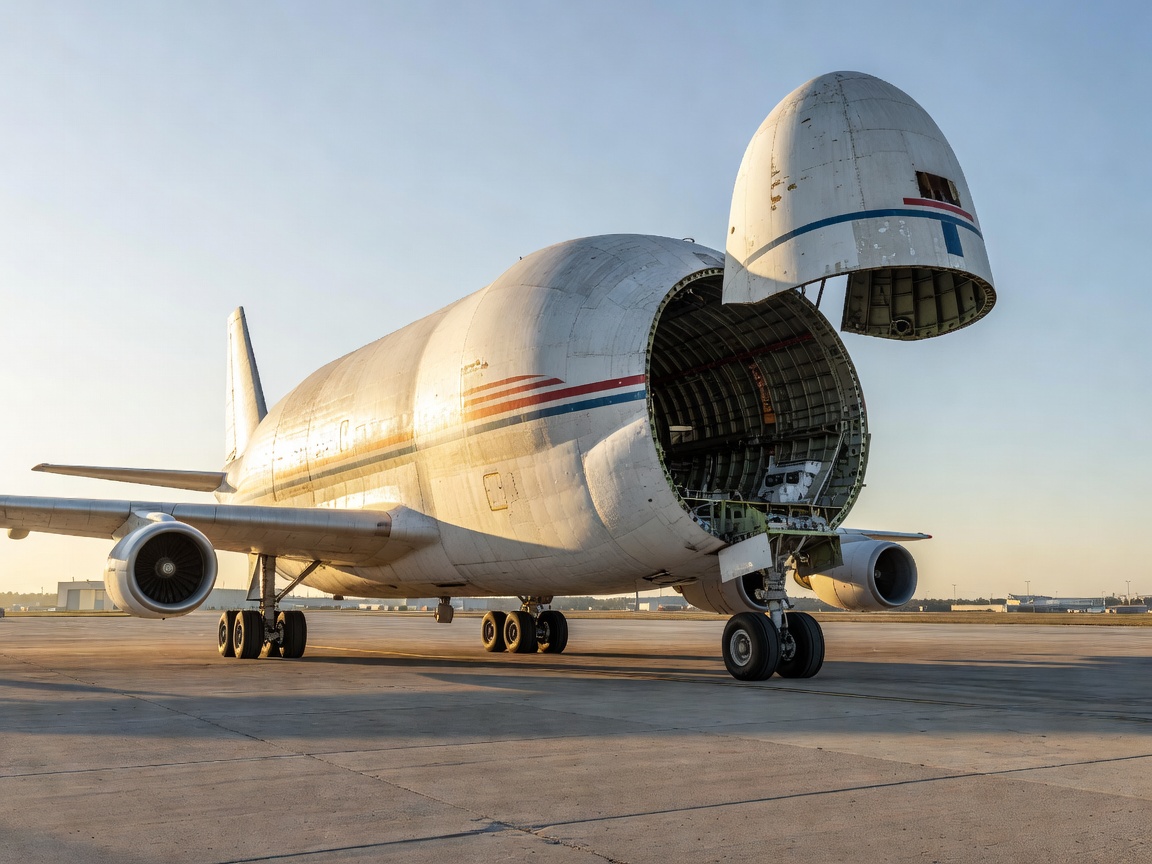
The Aero Spacelines Super Guppy is perhaps the most famous example of brute-force aerodynamics. Engineered to transport outsized cargo components for NASA's Apollo program, its swollen upper fuselage allows it to swallow entire rocket stages intact. The nose of the aircraft swings open via specially designed hinges to allow unobstructed forward loading.
"It doesn't look like it should fly. But aerodynamics is a science of fluid dynamics, not aesthetics."
Antonov An-225 and Stratolaunch
While the Guppy excels in volume, the Antonov An-225 Mriya set the standard for pure payload weight, capable of lifting up to 250 tons, originally designed to carry the Buran spaceplane. Modern successors like the Stratolaunch—featuring a dual-fuselage design and an unprecedented 385-foot wingspan—are built explicitly to carry aerospace launch vehicles to the stratosphere before dropping them for ignition.
| Aircraft | Wingspan | Max Takeoff Weight | Engines |
|---|---|---|---|
| Super Guppy Turbine | 156 ft 3 in | 170,000 lb | 4 × Allison T56 turboprops |
| Antonov An-225 Mriya | 290 ft 0 in | 1,410,958 lb | 6 × Progress D-18T turbofans |
| Stratolaunch Roc | 385 ft 0 in | 1,300,000 lb | 6 × Pratt & Whitney PW4056 |