Engineering the Extreme Payload Lift
There exists a threshold of mass where traditional wheeled transport fails, axles snap, and the asphalt liquefies under pressure. Past this limit, heavy lift logistics requires synchronized multi-axle platforms and continuous tracks.
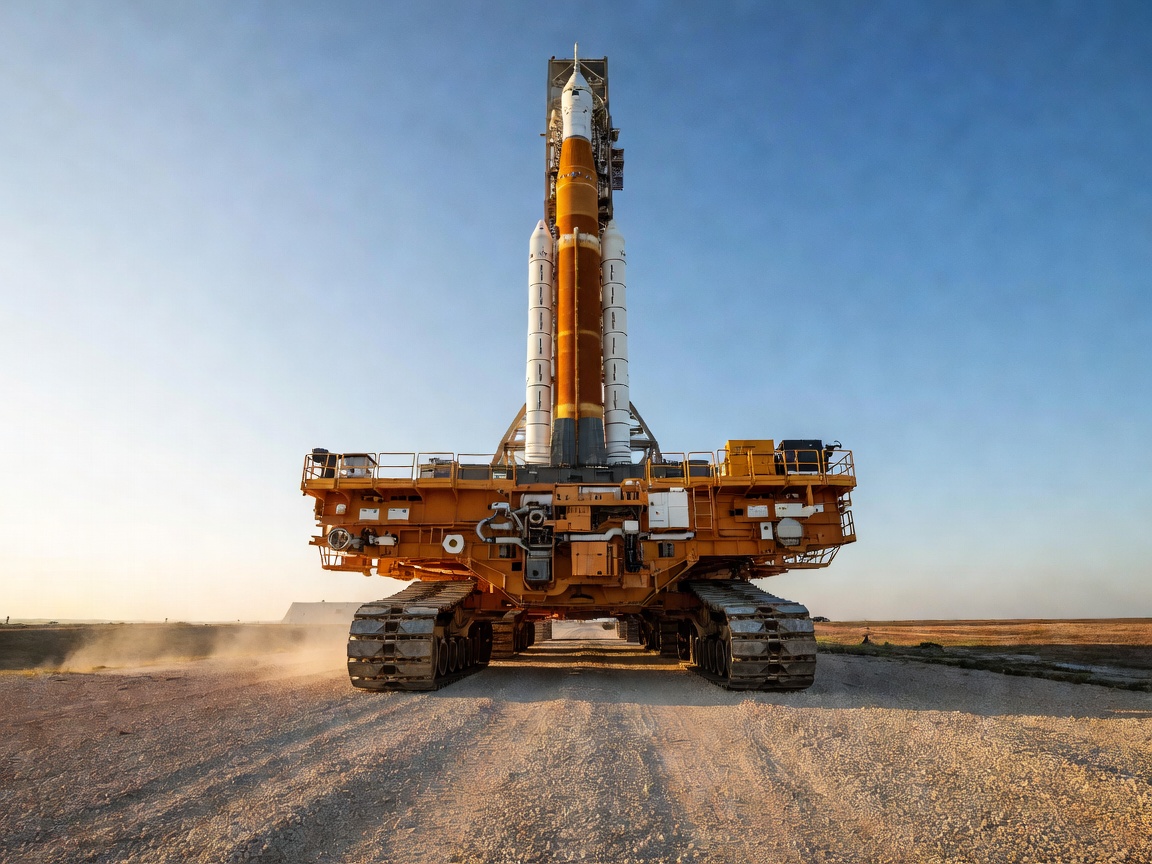
The crown jewel of singular heavy lifting remains the NASA Crawler-Transporter. Originally built for the Apollo program and subsequently modified for the Space Launch System (SLS), the Crawler measures 131 feet long and 114 feet wide. It carries up to 18 million pounds at a staggering top speed of 1 mph fully loaded, adjusting hydraulics in real-time to keep the multi-billion-dollar payload perfectly level.
"Every journey of a thousand miles begins with a single step. For the Crawler, a journey of four miles takes an entire day and consumes 125 gallons of diesel per mile."
Self-Propelled Modular Transporters (SPMTs)
For industrial applications, Mammoet and Scheuerle utilize SPMTs. These modular platforms can be joined together mechanically and controlled by a single computer interface to act as one cohesive vehicle. They are frequently employed to move entire bridge spans, petrochemical refinery towers, and naval ship sections, boasting hundreds of independently steerable wheel bogies.
The Bagger 288 Excavator
Though not a transport vehicle in the traditional sense, the Bagger 288 is the heaviest land vehicle in the world, weighing approximately 13,500 tons. Its design allows it to move on massive tracks across open-pit mines without sinking, displacing its weight so efficiently that its ground pressure is less than that of a walking human.